
Graham County Crime News Sources
Three outlets anchor local crime coverage here: Eastern Arizona Courier, Gila Herald, and Gila Valley Central. Graham County's own local-news directory lists all three. That confirms their reach in the Gila Valley. Their formats differ, though. The Courier comes closest to a regular blotter. Gila Herald posts frequent event-driven reports and sometimes runs an image supplied by the sheriff's office. Gila Valley Central covers selected events too. But a story there may carry a generic sheriff photo rather than a booking picture.
No official same-day, 48-hour, 72-hour, or weekly arrest feed exists at the county level. The sheriff does publish a current Booking Roster document. The county does not treat that PDF as a fixed-window news feed. Safford, Thatcher, and the Town of Pima post no city arrest log either. News reports add narrative facts an agency releases. They can't replace a custody check, a historical booking request, or a court docket.
Graham County News Outlet Guide
Match the source to the question. A recurring activity summary works well for spotting that an event happened. An event-driven article may add agency statements or scene detail. For a narrow custody question, go to the official roster. Save unofficial archives for last. Age, gaps, and copied errors hide easily in them.
| Outlet | Coverage | Photo pattern | Best use |
|---|---|---|---|
| GCSO sources | Selected releases, roster, and public records | Photo availability varies by source and request | Official custody and agency record |
| Eastern Arizona Courier | Frequent sheriff and police activity stories | Not a systematic mugshot gallery | Recurring incident discovery |
| Gila Herald | Event-driven Graham County and Gila Valley reports | Sometimes uses an agency-supplied booking image | Reported event context |
| Gila Valley Central | Event-driven Safford and valley news | May use generic agency art | Reported event context |
| Mugshots.com Graham archive | Unofficial county archive with old filters | Visible entries can state no photo available | Secondary historical lead only |
| Other major aggregators | No verified Graham local section in the dated sweep | State pages do not prove county coverage | Do not substitute for local records |
Outlet details reflect editorial schedules and site inventories that can shift over time. A publication keeping an old story indexed says nothing about whether a person is still in jail or whether filed charges changed later.
Graham County Activity Reports
The Eastern Arizona Courier news section is the strongest recurring source for Graham County activity coverage. Recent stories often credit GCSO or Pima Police reports. They tend to sum up roughly the prior day's activity. The paper runs weekly but can push blotter-style items near daily when agencies supply reports. Treat that as a common pattern, not a promise.
A blotter story is edited journalism. It may pick certain calls, trim an agency narrative, or skip events with no public release. It does not cover every booking. It also can't confirm someone is still held. Pima Police activity shows up in Courier stories, even though the Town of Pima posts no official online blotter. The article is a report about an agency's report, not the department's full data feed. The Courier's Graham County crime-news landing is the recurring local source behind this outlet assessment.
Use the section to find a dated incident narrative. Then match it against county booking and court records.
Note: A prior-day activity summary is neither a complete arrest log nor proof that each named event led to jail intake.
Graham County Mugshots in News
Images reach readers through several paths. An agency may issue a press release with an approved booking photo. A journalist may request a releasable picture under Arizona public-record law. Or an outlet may choose a scene shot, a logo, or a generic illustration instead. The image choice says little about record availability. It reflects what material existed, the outlet's editorial call, and the story's needs.
The Gila Herald local-news section posts frequent event-driven reports rather than a fixed roster. In one Safford-area story, the outlet cited a GCSO release. It displayed a watermarked GCSO booking image. That proves occasional official-image use. It does not set a standing rule that every Graham County arrest story will carry a mugshot. The linked Gila Herald source image shows the section landing, not a gallery or rehosted booking photo.
The plain section view keeps attention on what the source does. The outlet's original report stays responsible for its own images and wording. Gila Valley Central, by contrast, paired a generic sheriff image with an arrest report credited to GCSO. Its local section still offers useful Safford and valley context. Just know the illustration was not the arrested person's booking photo.

That contrast is the lesson. Read the caption and the source attribution before assuming every picture beside an arrest story is a mugshot.
Trace Graham County Arrest News
A news story starts the search. The records finish it. The sheriff's current roster shows published county custody for the period the PDF represents. GCSO Records can supply a historical booking sheet or booking photograph when releasable. A court docket tracks filed charges and the case outcome. The Graham County busted mugshots hub pulls the county-wide roster and records-request paths into one place.
- Record the exact name, date, location, and agency named in the article. Keep the story's publication date separate from the event date.
- Check the official GCSO Booking Roster for present published county custody. Absence is inconclusive because the roster is not a history.
- Ask GCSO Records for the dated booking sheet and photo if needed. Identify the person, approximate date, and booking number when known.
- Search Arizona Public Access by careful identity details. Use the court and case number to avoid joining records for different people.
- Follow the docket or request the court file for the disposition. Charges can be declined, amended, dismissed, tried, or resolved later.
Custody shifts matter too. A fresh booking puts a name on the jail roster, but release or transfer can pull that name down while the booking file stays with GCSO. Once someone is sentenced to state prison, the record moves to ADCRR and off the county roster. News stories rarely flag any of these turning points. So treat an old article as a lead only, and confirm where the person actually stands through the agency holding the record.
Graham County Crime Case Trail
After booking, a case can land in several courts. Graham County Justice Court takes misdemeanors charged by county or state officers, plus criminal traffic. A felony may pass through a preliminary stage there before moving up to Superior Court. City-officer cases often head to municipal court instead. For that reason, the agency and case prefix in a news report can matter as much as the name attached to them.
The statewide Arizona Public Access case lookup is the widest starting point. It covers most Arizona courts, though not all, and sealed or sensitive cases stay out. An empty result does not mean nothing was filed. Try spellings, middle names, the right court, filing lag, and a case number if the story lists one.
For a matter filed in this county, the Superior Court and Justice Court pages give direct clerk paths. The formal outcome in the court file is called the disposition. It might show a dismissal, a plea, a verdict, or a sentence. Whatever that entry says controls over the arrest wording an older article keeps repeating.
Note: Keep the article date, booking date, and court filing date distinct because each records a different point in the case.
Graham County Mugshot Archives
Try unofficial archives last. Check the sheriff, police, news, and courts first. The one major aggregator with its own local section is Mugshots.com Graham County. Its county filters end around 2012 and 2013. Some entries show only "No Mugshot Available." So it is a stale archive, not a place to find recent Graham County bookings. City filters for Safford, Thatcher, and Pima exist on the site. Still, a label proves nothing about age or identity.
Treat the archived page as a lead at most. Verify the identity, dates, custody status, and outcome with GCSO and the right court. A location tag plus old filters is not proof of a current Graham County arrest.
The RecentlyBooked Arizona inventory lists counties across the state without including Graham. Its image is of a state catalog, not local coverage.
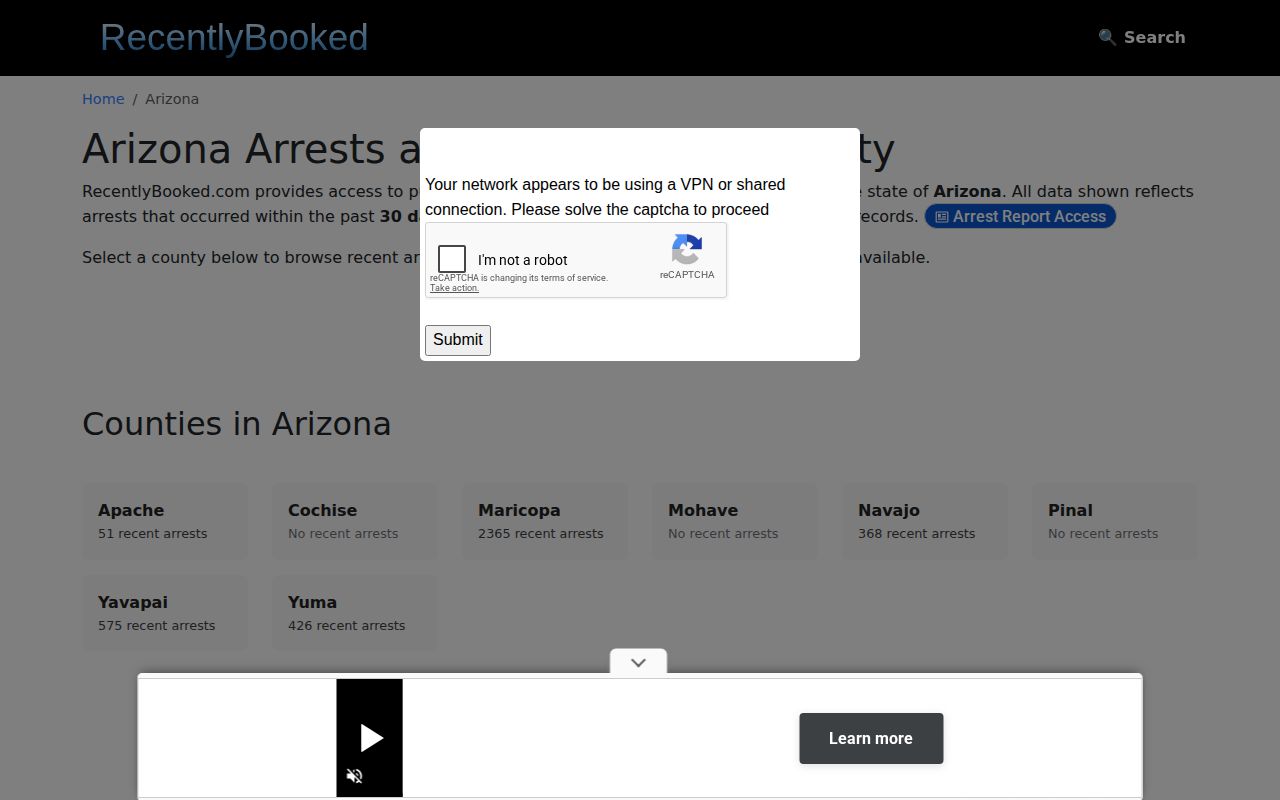
Other publishers come up empty here too. Busted Newspaper's Arizona category has no Graham County page or Graham posts. Arrests.org names several Arizona counties but skips Graham. Mugshots.zone shows no Arizona section at all. Never guess at county URLs. Never read a state-level page as evidence that a site covers Graham County. Inventories do shift, so test any claim against the live site and note when it was published.
Read Graham County News Carefully
A newspaper answers only to its own publishing choices. An arrest story can stay indexed long after release, transfer, dismissal, amendment, or sealing changes the picture. The piece may have quoted the agency accurately on day one. Even so, it can fall short as a current account. That is not an error so much as a reason to pair the article with the originating record and the later court file.
Names repeat across people. A booking photo does not settle identity on its own. A similar face is not sound proof. Rely on case numbers, booking numbers, dates of birth where the official system allows, agencies, and dates instead. Read any correction alongside the original story. If a case is sealed or restricted, follow the current access rule and draw nothing from a missing result.
Keep the roles straight. GCSO runs county custody and booking products. A city police department holds its own incident reports. Clerks keep the filed court records. Local outlets choose what becomes news, while unofficial archives may copy, omit, or lag behind all of them. Holding those jobs apart turns Graham County crime news into a useful lead.